Picture: ZugEstates AG
From O₂ production to CO₂ reduction
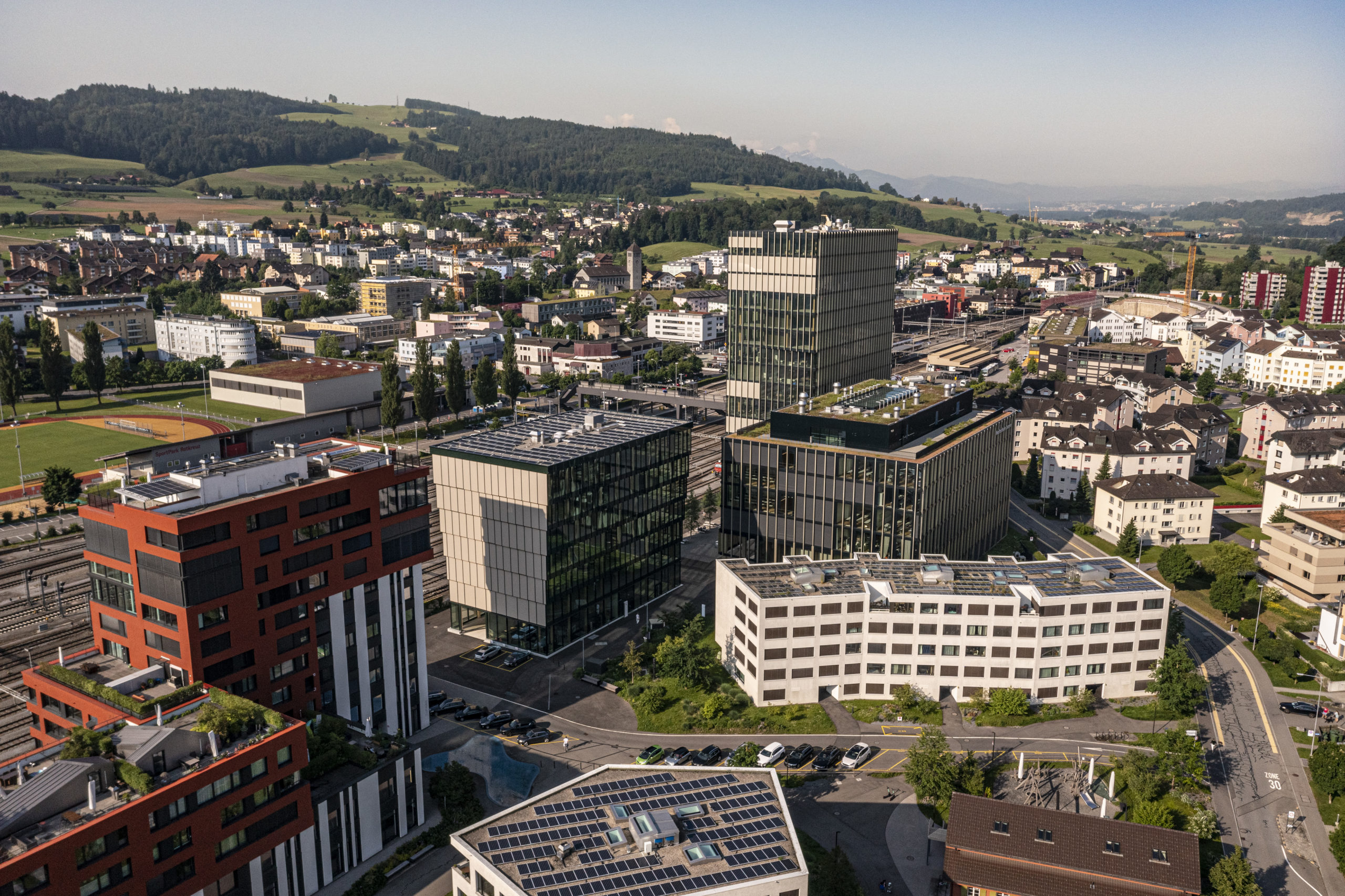
“Suurstoffi” is the Swiss German word for oxygen. In 1926, the company Sauerstoff- & Wasserstoff-Werk Luzern AG built a brick building in Rotkreuz that later became known as Suurstoffi. Almost a century later, the site was acquired by Zug Estates AG, which is transforming it into a CO₂-neutral neighborhood. Today, Suurstoffi is an urban neighborhood hosting around 1’500 residents, 2’000 students and 500 employees. The area is known for its innovative architecture, including Switzerland’s largest wooden building and a vertical garden tower. At the same time, Suurstoffi functions as a Living Lab, where SWICE WP6 researchers and partner institutions investigate how mobility, teleworking and energy consumption interact in everyday life.
Mobility patterns
Although the neighborhood is well connected to public transport and car-free in its center, the surrounding roads are heavily used by cars. A survey conducted in 2023 revealed high levels of car use among residents, compared to Swiss averages, and a high number of home-office rooms in their homes. These findings highlighted the importance of interventions addressing commuting behavior, particularly in the context of patterns related to new work such as teleworking (e.g. use of home-office and coworking-spaces).
Living Lab-Activities and interventions
Mobility Roundtable and consultations for companies
A central element of the Living Lab is the Mobility Roundtable, which brings together the area developer, the municipality of Risch-Rotkreuz, companies and research partners. The event serves as a platform for exchange and as a starting point for measures, including consultations for companies on mobility management. These consultations aim to support companies in reducing the environmental impacts of employee commuting through tailored strategies and cooperation across the neighborhood.
Coworking trial for residents
Several interventions for residents in the Living Lab emerged through participatory processes. One initiative was a coworking trial in which residents received free access to a residential coworking space for three months. The intervention explored whether working closer to home could reduce commuting and energy use. Results showed reductions in commuting distance, travel time and related CO₂ emissions. Participants also reported improved work-life balance and increased social interaction, and many indicated that access to nearby coworking facilities could influence future housing decisions by reducing the need for dedicated home-office room.
Distribution of “Heat-Kits” for residents
Another intervention, in collaboration with WP5, addressed the relationship between heat and mobility behavior. In summer 2025, researchers distributed “heat kits” with simple cooling tools such as fans, spray bottles and cooling towels to selected households. The aim was to understand how heat waves influence everyday mobility decisions in dense urban environments. The findings showed that during hot periods residents tended to walk less, shift trips to cooler times of day and avoid unshaded routes, while bicycles and motorized transport were used more frequently. Although personal cooling tools were perceived as helpful, participants emphasized that long-term adaptation requires climate-sensitive urban design, including shaded areas, green areas and water access.
Mobility-Challenge for students and employees
A mobility challenge targeting students and employees at the university campus tested a gamified approach combining tracking, financial rewards and social-norm communication. The experiment showed that neither monetary incentives nor behavioral nudges produced measurable changes in travel behavior, suggesting that short-term competitions alone are unlikely to shift mobility habits. The learning was that interventions need to go beyond small rewards and information campaigns. More substantial measures, such as stronger incentives, longer time horizons, personalized feedback or structural changes in infrastructure and mobility options, are required to achieve behavior change.
Key insights
Overall, the Suurstoffi Living Lab demonstrates how real-world experimentation can generate practical insights into sustainable mobility transitions. The research shows that teleworking can reduce commuting emissions but also increase energy use at home, that neighborhood coworking spaces can help balance sustainability and wellbeing, and that environmental conditions such as heat shape mobility behavior. By combining participatory processes with scientific evaluation, the Living Lab provides a example of how mobility, energy and urban development can be integrated in the transition towards more sustainable neighborhoods.